Learn Why Interventional Glaucoma is the Evolved Standard of Care
Doubling the likelihood that patients maintain follow-up visits and receive AAO-recommended visual fields, Interventional Glaucoma (IG) is a proactive, procedure-first approach designed to address barriers to long-term disease control before vision is lost.1
Transform your glaucoma management today! Adopt the consensus protocol.
Interventional Glaucoma Helps Move Care Forward
-

Earlier insight
Uses predictive diagnostics and ongoing monitoring to guide treatment before vision is at greater risk.
-

Earlier action
Moves beyond a wait-and-escalate model by intervening before significant progression or adherence challenges compromise outcomes.
-

Greater control
Uses effective procedures earlier in the disease course to reduce dependence on drops and help physicians maintain control of long-term care.
A Stepwise Interventional Glaucoma Care Protocol
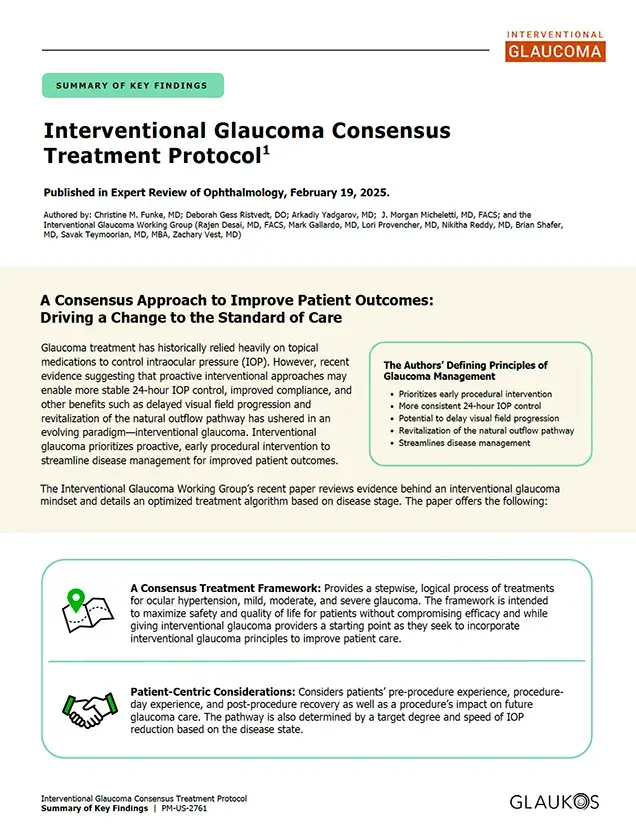
A consensus protocol was developed by eleven leading Ophthalmologists. The Interventional Glaucoma Working Group* reviewed individual treatment strategies and established a consensus-based framework tailored to each stage of disease progression.1
-
Ocular Hypertension
- Lasers
- Procedural pharmaceuticals**
- Tissue-sparing MIGS
- MTMT
-
Mild Glaucoma
- Lasers
- Procedural pharmaceuticals**
- Tissue-sparing MIGS
- Non-tissue-sparing MIGS procedures
- MTMT
-
Moderate Glaucoma
- Lasers
- Procedural pharmaceuticals**
- Tissue-sparing MIGS
- Non-tissue-sparing MIGS Procedure
- MTMT
- Filtering surgery
-
Severe Glaucoma
Favoring a more aggressive intervention, skipping laser to focus on a combined protocol of procedural pharmaceuticals** and tissue-sparing MIGS followed by non-tissue-sparing MIGS if IOP is not controlled. Filtering surgery is still the last resort but may be considered when prompt and substantial reduction of IOP is imperative to prevent irreversible optic nerve damage.
- Procedural pharmaceuticals**
- Tissue-sparing MIGS
- Non-tissue-sparing MIGS procedures
- MTMT and/or lasers
- Filtering surgery
- *Glaukos provided reimbursement for the Interventional Glaucoma Working Group’s time and travel expenses to allow them to participate in consensus-building discussions. **Not available and cannot be legally used outside of the United States. Bridge therapy: Drops used as a temporary treatment while patient awaits procedural intervention. Supplemental: Drops used in addition to a procedural intervention. MTMT: Maximum tolerated medical therapy. Tissue-sparing MIGS: Either trabecular bypass or canaloplasty.
Transform your glaucoma management today! Adopt the consensus protocol.
Interventional Glaucoma Consensus Treatment
Protocol
IG Avoids Drops and Can Be Considered For a Variety of Patients
-

Noncompliant/nonadherent to topical glaucoma medication(s) with medical justification
-

Intolerant or allergic to topical glaucoma medication(s)
-

Experienced side effects from topical glaucoma medications
-

Uncontrolled on topical glaucoma medication(s)
-

Underlying comorbidities (eg, ocular surface disease)
-

Underwent prior intervention (eg, SLT) and remain in need of therapy
A Range of Treatment Options
Advancements in therapeutic options have addressed the limitations of drops by
effectively lowering IOP without relying on patient self-application of topical pharmaceuticals.
The IG Consensus Protocol includes a variety of treatment options:2
Primary Therapy:
-

Lasers
Non-invasive selective laser trabeculoplasty (SLT) to enhance outflow.
-

Procedural Pharmaceuticals**
Sustained-release drug delivery systems that provide ongoing IOP control without daily patient action.
-

Tissue-Sparing MIGS
Minimally invasive procedures that preserve ocular structures.
-

Non-Tissue-Sparing MIGS
Procedures that remove or modify tissue to improve aqueous outflow, resulting in more aggressive IOP reduction.
Bridge and Supplemental Therapy:
-

Drops
Drops are used as a bridge and supplemental treatment when needed.